
Gone are the days when a home office was just a laptop perched on a dining table or a dark corner of the guest room. As remote work becomes a permanent fixture of our professional lives, the “home office” has evolved into a high-stakes design project.
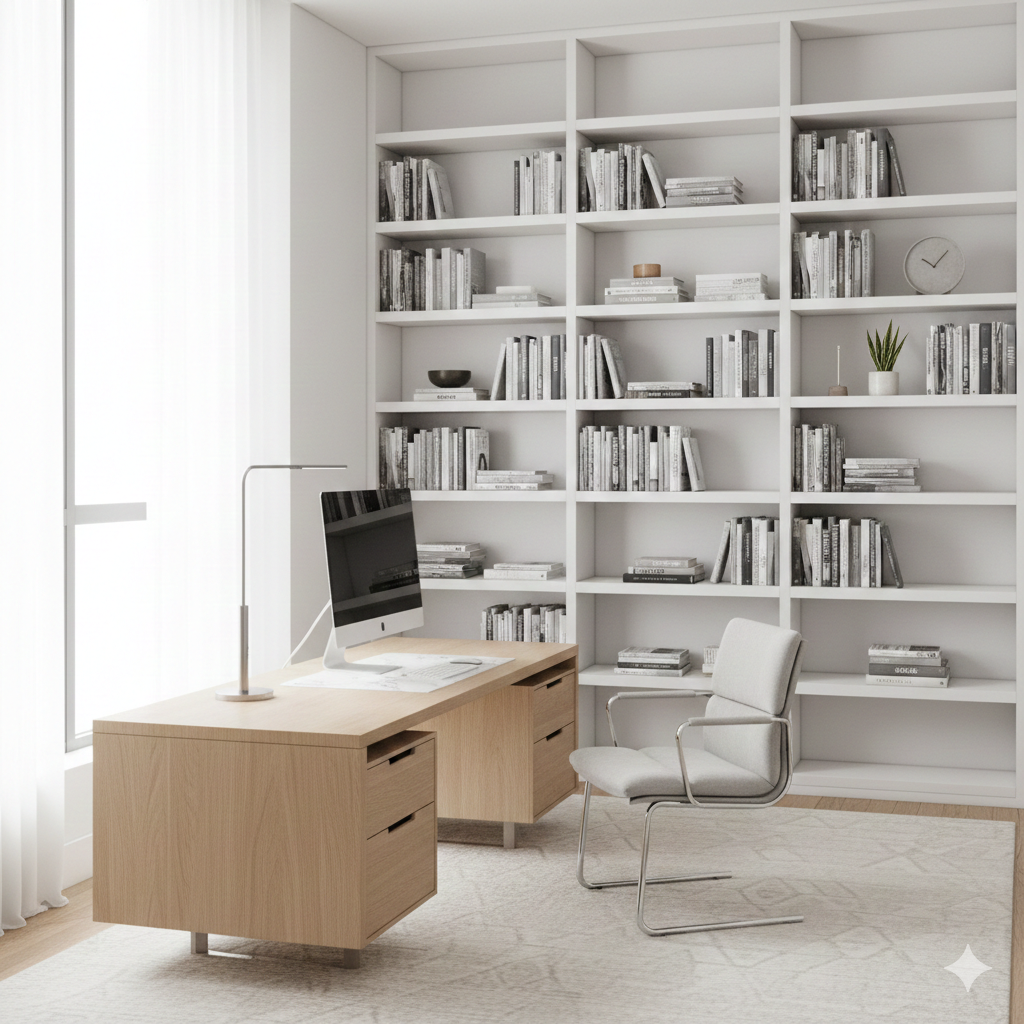
A professional home office isn’t just about a desk and a chair—it’s about creating an environment that signals to your brain (and your Zoom callers) that you are focused, capable, and inspired. Here is how to curate a workspace that looks as sharp as your professional reputation.
1. The Power of the “Zoom Background”
In the modern workplace, your office wall is your new business card. A cluttered or blank background can feel impersonal or chaotic. A professional aesthetic requires a curated “Power Wall.”
- The Bookshelf Pivot: Instead of cramming shelves full of paperbacks, use the 60/40 rule: 60% books and 40% “breathing space” for art, a sleek clock, or a sculptural plant.
- Symmetry and Art: If you prefer a clean look, hang a single, large-scale piece of abstract art or a set of three symmetrical frames. This provides a sophisticated, “executive” backdrop that isn’t distracting.
2. Ergonomics in Disguise
Nothing ruins a high-end aesthetic faster than a clunky, neon-accented gaming chair. However, a “pretty” chair that leaves you with back pain is equally useless.
The Hidden Desk: If your office is part of a multi-purpose room, consider a “floating desk” or a sleek writing bureau. This keeps the room looking like a home while providing a dedicated professional zone.
The Aesthetic Solution: Look for executive chairs upholstered in cognac leather, high-quality linen, or mesh with a slim profile. Brands are increasingly designing ergonomic chairs that look like mid-century modern furniture.
3. Layered Lighting for Focus
As we discussed in Lighting Layers, a single overhead light is the enemy of productivity. In an office, you need a specific balance:
- Natural Light: Position your desk perpendicular to a window. This gives you the benefit of daylight without the glare on your screen.
- Task Lighting: A high-quality LED desk lamp with an adjustable neck is essential. Choose a finish that matches your hardware (brass, matte black, or chrome) to tie the room together.
- Temperature Control: Use bulbs in the 3500K – 4000K range (Cool White). It mimics daylight and keeps you more alert than the warm, yellow tones used in bedrooms.
4. Texture and “The Executive Touch”
To move from “spare room” to “professional suite,” you need to add tactile elements that feel expensive and intentional.
5. Managing the “Tech Chaos”
Wires are the visual “noise” that kills a professional aesthetic. A high-end office looks effortless because the technology is invisible.
- Cable Management: Use under-desk cable trays and cord covers to hide the spaghetti of wires.
- Docking Stations: Invest in a single-cable docking station so your desk remains clear of adapters and dongles.
- Tech Concealment: If you have a printer, hide it in a ventilated cabinet or on a sliding shelf rather than letting it sit on the desk surface.
Final Thought: Design for the Work You Want
Your environment dictates your energy. By treating your home office with the same design rigor as your living room, you create a psychological boundary: when you step into this beautiful, curated space, you are in “Professional Mode.”